The 5 Biggest Mistakes Parents Make When Planning Kids Parties
May 4, 2026

Planning a kids party for children aged 12 and under is very different from adult events. Kids don’t naturally regulate energy, follow timelines, or transition smoothly between activities. They need structure, pacing, and clear guidance to stay engaged.

Most party problems don’t come from bad ideas — they come from poor flow and timing.

Here are the five most common mistakes parents make when planning a kids party, and how to avoid them using a structured kids disco party approach like Jitter Bug Discos in Melbourne.

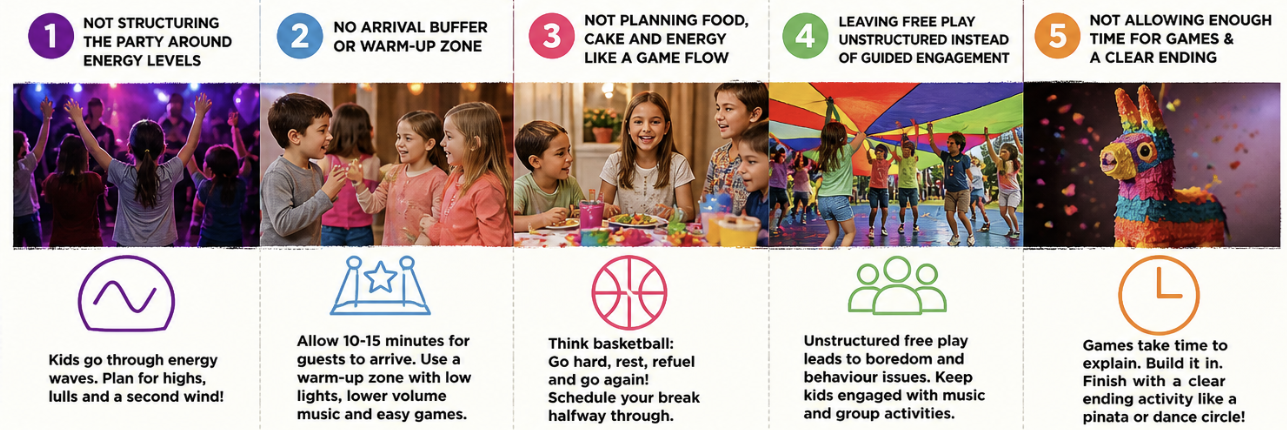
1. Not Structuring the Party Around Energy Phases


One of the biggest mistakes is treating a 2-hour party as a flat block of time.

Kids don’t maintain one level of energy — they move through cycles:

  • Arrival excitement
  • High-energy peak
  • Natural drop-off
  • Second wind before finishing

A successful kids birthday party DJ setup works with these waves instead of against them.

Think of it like a rhythm, not a schedule — energy must rise, fall, and rise again in a controlled way.

At Jitter Bug Discos events, this is managed through planned shifts in music, games, and activity intensity so kids stay engaged without burning out.

2. No Arrival Buffer or Warm-Up Zone


A common mistake is starting structured games immediately as kids arrive.

The problem is arrivals are staggered — some kids are early, some are late, and most are still adjusting to the environment.

Jumping straight into instructions causes:

  • Kids missing key explanations
  • Repeating rules multiple times
  • Uneven engagement at the start
  • Some children feeling left behind

Better approach: Build in 10–15 minutes of arrival time

This should include a warm-up zone, such as:

  • House lights on (not full disco lighting yet)
  • Lower volume background music
  • Simple “follow the DJ” movement games
  • Easy, no-pressure welcome interaction activities

This transition phase is critical. It prevents overwhelm and helps kids ease into the party environment.

3. Not Managing Food, Cake, and Energy Like a Game Flow


One of the most effective ways to understand kids party structure is to think of it like a basketball game:

  • Kids go hard (first half energy)
  • Then they take a break (timeout / refuel)
  • Then they go hard again (second half energy)

A 2-hour kids party should follow this exact structure:

  • 45–60 mins: high-energy games and dancing
  • Midpoint: food or cake break
  • 45–60 mins: re-engagement and structured activities

Why this matters:

  • Kids physically need to refuel
  • It resets attention and behaviour
  • Prevents burnout in the final 30 minutes
  • Improves engagement for the second half

A structured kids disco party in Melbourne like Jitter Bug Discos builds this into the flow so it feels natural, not forced.

4. Leaving Free Play Unstructured Instead of Guided Engagement


Free play often seems like a safe filler, but in group party settings it is one of the most common points where things start to fall apart.

Without structure:

  • Kids split into small disconnected groups
  • Energy becomes uneven
  • Engagement drops quickly
  • Behaviour issues start to appear

Better approach:

Instead of unstructured free play, use:

  • DJ-led movement games
  • Music-based group activities
  • Structured “interactive downtime”

Even when kids are not doing formal games, they should still be lightly guided through music and interaction.

This keeps momentum without overwhelming them.

5. Not Allowing Enough Time for Games, Instructions, and a Clear Ending

This is one of the most overlooked mistakes.

Every game has three parts:

  1. Explanation
  2. Demonstration
  3. Participation

And most parents only plan for the third part.

The reality is explanations alone can take 5–10 minutes depending on age and group size. If you don’t factor this in:

  • The schedule runs behind
  • Kids lose attention before starting
  • Transitions feel rushed and chaotic

Professional approach:

  • Keep instructions short and visual
  • Demonstrate instead of over-explaining
  • Allow buffer time between activities

Most importantly: Always plan a clear ending activity

A kids party should never just “fade out.”

The ending should be intentional and structured, such as:

  • Pinata-style group activity
  • Dance circles where everyone participates
  • Final high-energy group dance
  • Confetti or celebration moment (if suitable)

This gives closure and creates a strong final memory of the event.

At Jitter Bug Discos, the final 10–15 minutes are always planned as a high-energy group finish so the party ends on a peak, not a wind-down.


Final Thoughts


A successful kids party isn’t about adding more activities — it’s about controlling flow, timing, and energy transitions.

For children aged 12 and under, the key structure is:

  • Controlled arrival warm-up phase
  • Clear energy cycles throughout the party
  • Mid-party refuel break (food or cake)
  • Guided engagement instead of free play
  • Planned transitions and clear ending moment

This is why structured kids disco entertainment like Jitter Bug Discos in Melbourne works so well — it’s built around how kids actually behave, not just a checklist of activities.
By Josh McKinlay April 9, 2026
How to Make a Kids Disco Inclusive (So Every Child Can Join In) One of the most important goals of any kids party isn’t just having fun it’s making sure every child feels included. At a kids disco, that doesn’t happen by accident. It comes down to how the music, games, and environment are run. At Jitter Bug Discos, we design our discos so that every child has the opportunity to take part and enjoy the experience in their own way. Here are some of the key ways an inclusive kids disco can be created. Creating an Inclusive Kids Disco An inclusive kids disco isn’t about making things quieter or less fun. It’s about creating the right balance so that every child has a chance to participate. By keeping kids involved in games, matching activities to the age group, starting slow and building energy, managing sound and lighting properly, and being aware of sensory needs, it’s possible to create a disco where every child can feel comfortable joining the fun. That’s the approach we take at Jitter Bug Discos — creating kids discos where everyone has the chance to be part of the party Keeping Every Child Involved One of the biggest mistakes at kids parties is using games where children get eliminated and end up sitting on the sidelines. Sitting out quickly becomes boring and can make some kids feel left out. Instead of elimination games, activities should keep everyone involved from start to finish. For example, games like musical statues can be redesigned so that instead of children being eliminated, the group can be divided into teams and one team wins the round while everyone continues playing. The goal is participation rather than elimination. When kids stay involved, the energy stays high and the dance floor stays full. Matching Activities to the Age Group A good kids disco also needs to match the games and dances to the age group of the children attending. If activities are too difficult for younger children, they become confusing and frustrating. If they are too simple for older children, they can quickly become boring. For example, more complex dances can be challenging for very young children, while very simple dances may not engage older kids. Finding the right balance helps keep everyone involved and enjoying themselves. Starting Slow and Building Energy One of the most important — and often overlooked — parts of an inclusive disco is how it starts. Walking into a loud, high-energy environment straight away can feel overwhelming for some children. A better approach is to start with: Lower volume music Slower, familiar songs A relaxed atmosphere as children arrive As more children settle in and feel comfortable, the energy can gradually build: Music becomes more upbeat Games and interaction increase The dance floor naturally fills This helps children ease into the environment rather than being thrown into it, making it much more inclusive for those who need time to adjust. Creating a Sensory-Friendly Environment For some children, particularly those with sensory sensitivities, a disco environment can feel overwhelming if it is not managed properly. With the right setup, however, a disco can still be enjoyable and comfortable for everyone. Sound Setup Speaker placement makes a big difference. When speakers are positioned above head height, the sound travels more evenly through the room. This means the music can be heard clearly without needing to be excessively loud, which helps protect sensitive ears and creates a more comfortable environment for younger children. Lighting Control Lighting can make or break the disco experience. Professional lighting, like what I use with DMX control, allows me to: Adjust brightness and speed of movement Create effects without overwhelming kids Match the mood to the age group and energy level Not everyone can invest in professional lights, and that’s okay. If you have a few different lights, you can still create a good experience by turning them on and off at different times . For example: Start with only one or two lights while kids arrive Gradually add more as they settle in Keep brighter or flashing lights for later games, not right at the start This helps manage sensory input and keeps all children comfortable while still making the disco fun and engaging. Allowing Children Time to Adjust Walking straight into a loud, busy environment can be a lot for some children. Setting up early and allowing children to see the space before the disco begins can help them feel more comfortable. When children have the chance to explore the space and understand the environment first, they are often more confident about joining in once the music starts. Simple Supports That Can Help Some children may benefit from small supports that help them manage sensory input while still being part of the party. Things like sunglasses to reduce brightness or noise-reducing headphones can make a big difference. For some children, sensory tools such as chewy items or fidget items can also help them stay regulated and comfortable in a busy environment. Communication is also important. If parents let the DJ know about any specific needs ahead of time, adjustments can be made during the disco if needed.
By Josh McKinlay January 30, 2026
Creating a Disco Dance Playlist With Your Kids — fun tips to build a groovy family playlist and get everyone moving. Read now for party inspiration!